
Close the gap between threat detection and response
Written by Joel Kisner, Owner/CEO @ Pinnacle Consulting | Law Enforcement Operations
The data behind law enforcement response times, the limits of current programs, and the technology built to fill the gap.
75% of active shooter incidents in 2024 ended before law enforcement ever arrived.
Not because officers were slow. The reality is that an assailant’s timeline starts long before they ever enter a location.

An attacker’s preparation often begins long before they ever walk through the door. Planning, preparation, and intent are already in motion. But for the purpose of this article, we are focused on one window: the time between the moment an attacker enters a location, and the moment law enforcement arrives. In that window, people are killed, others are wounded, and survivors are left carrying that experience for life. Until now, we had no way to change that.
The FBI’s 2024 Active Shooter Incidents in the United States report, released in June 2025 and the most current data available, found that even in education settings the average police response time was one minute and 48 seconds. The response time is fast. The average incident duration in those same education settings was three minutes and 18 seconds. Over three minutes is a very long time for an attacker to have the freedom to maim and kill others. Three of the four school shooters completed their attacks before officers could intervene.
It’s important to understand that the average response time in the FBI report is the best-case scenario. Across all settings, someone inside the event first must recognize what is happening. That recognition period alone usually takes multiple minutes. Then someone has to feel safe enough to place a 911 call, relay what they know to the call taker, and wait for resources to be dispatched. This process of incident recognition, protective action by people at the site, and reporting adds another 4 to 11 minutes. Stack it together and the total elapsed time from first aggressive action by an attacker to first officer on scene can reach 10 to 20 minutes in actual time.
The FBI’s data across 25 years of study tells us that 69% of active shooter incidents end in five minutes or less, with over a third ending in under two minutes. The Department of Homeland Security has stated that these incidents move so fast that by the time responders arrive, it’s often too late to intervene.
Before we talk about what fills that gap, it’s worth understanding how much damage a single attacker with a firearm can do in that amount of time. According to the Bushmaster AR-15 owner’s manual, the maximum effective rate of aimed fire for that platform is 45 rounds per minute. Research from the Force Science Institute found that even inexperienced shooters can cycle rounds at a cadence of one quarter to one third of a second per shot with a semi-automatic firearm. A Campbell University School of Law analysis concluded that the average shooter with an AR-15 will fire two to three rounds per second, emptying a 30-round magazine in roughly ten seconds. Factor in a reload of two to four seconds and an average shooter can deliver between 45 and 90 aimed rounds in a single minute. Even at the low end of that range, 45 rounds have been fired before anyone has likely picked up a phone to call 911.
What do we tell the people inside that building during those minutes?
The current response models available to people inside these events include:
· Run, Hide, Fight;
· Avoid, Deny, Defend;
· Alert, Lockdown, Inform, Counter, Evacuate;
· Prevention, Response, Options.
Every one of these models depend on the individual to process what is happening, make a life-or-death decision, and carry it out under extreme stress, all before any outside help has arrived. With all respect to the training behind these programs, what we are really asking people to do is survive on their own and hope it works. Hope is not a tactic.
None of them provide a reliable way to warn others in the building about what and where the danger is. None of them give responding officers eyes on the threat before they arrive or while they are on scene advancing towards the attacker. And none of them introduce any form of disruption to slow or redirect the attacker during the gap between the first shot and the first officer on scene.
That gap is not a training problem. It’s an operational void.
Consider this reality. We require buildings to install sprinkler systems and fire alarms not because we expect them to replace the fire department, but because we know the fire department cannot arrive instantly. Those systems detect the threat, alert the people inside, slow the spread of damage, and some can give first responders additional information before they walk through the door. That is the accepted standard for fire. Nobody questions it.
For active threats, we have never applied the same logic. Yes, there are pieces in place. Acoustic gunshot detection can identify the sound of a weapon being fired. Visual analytics can flag a weapon on camera. Metal detectors can screen for firearms at entry points. But these tools are largely standalone. They are not connected to each other in any standard way, they are often not tied into a unified alert and response process, and none of them do anything to slow or disrupt the threat once it begins. There is no equivalent to the sprinkler system that activates the moment a fire is detected.
You have likely seen Drone as First Responder programs in the media. DFR is a proven concept and a strong example of what these platforms can accomplish outdoors. Outdoor drones require a licensed pilot and additional personnel to operate. Traditional DFR drones require GPS to operate. Indoor capable drones exist, but they have range limitations dictated by the structure and still require personnel on site to fly them, pulling members away from the response itself.
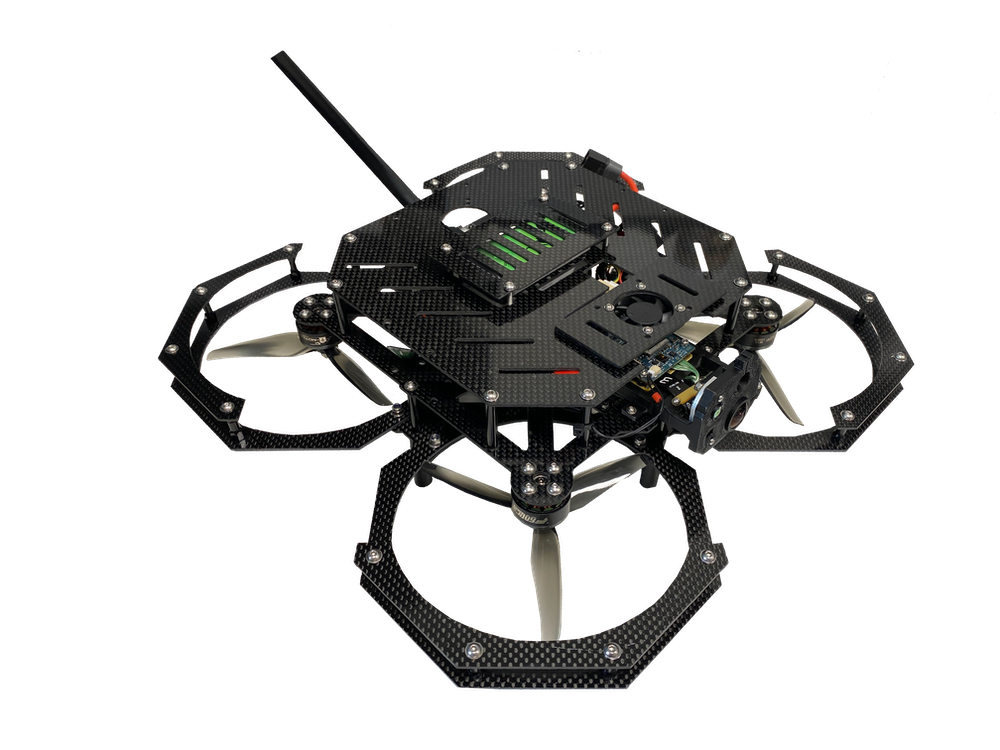
Indoor Drone as First Responder (iDFR™) takes the DFR concept and moves it inside on a purpose-built platform designed for GPS denied environments. The iDFR™ operates on its own communication network that can function even when power is lost or existing camera systems fail. It launches in seconds from a docking station. The iDFR™ includes 360 degree collision avoidance, onboard analytics, other proprietary technologies and delivers a live encrypted video feed directly to responding law enforcement. It also carries nonlethal firearm disruption capability, making it the only drone platform with that function.
Outdoor DFR programs require a certified drone pilot either onsite or nearby to launch and operate the aircraft, along with approvals and waivers that most operations must obtain before flying. That is at minimum one trained person dedicated solely to the drone. If the system operates under line-of-sight rules, that number grows because you now need a visual observer and potentially a security person to protect the flight crew. In a school or a facility with a small security team, those may be the only people you have. Pulling them from the response to fly a drone leaves a gap in the team managing the event. iDFR™ eliminates that problem entirely.
iDFR™ was designed to eliminate that problem. The platform supports three modes of operation: fully autonomous flight where the drone launches and navigates on its own using pre-mapped routes and 360 degree collision avoidance, semi-autonomous flight where an operator can direct the drone to specific areas while the system handles navigation and obstacle avoidance, and full manual control by an operator in a security operations center or onsite if the situation requires it. No specialized drone pilot certification is needed for the operator. The training program is straightforward and easy and I can provide the standard operating procedures The system is built so that existing security staff can manage it as part of their normal duties from the operations center.
That means no one is pulled from the response. No one on site has to stop what they are doing to fly a drone. The people responsible for evacuation, communication, and coordination with law enforcement stay focused on those tasks. The iDFR™ provides real time video and situational information to both the onsite team and the responding officers without adding a single task to the people already managing the crisis.
The value extends well past the active shooter scenario. Open door alarms. Unwanted activity on campus. Smoke or fire in a wing of the building. Any situation where your team needs real time eyes before committing personnel to an unknown environment. This platform delays, distracts, and slows incidents while giving your people the information they need to apply the right response and protect lives and property.
iDFR™ does not replace law enforcement. It fills the void that exists before they arrive and supports your operation long after the emergency is over.
The question is not whether people inside these events are brave enough. They are. The question is whether we owe them more than a checklist and a clock they cannot stop.
Sources
FBI, Active Shooter Incidents in the United States in 2024 (June 2025): fbi.gov/file-repository/reports-and-publications/2024-active-shooter-report
FBI, A Study of Active Shooter Incidents in the United States Between 2000 and 2013 (2014): fbi.gov/file-repository/active-shooter-study-2000-2013-1.pdf
Katherine Schweit, Understanding the FBI’s 2024 Active Shooter Data, Police1 (July 2025): police1.com/active-shooter/understanding-the-fbi-2024-active-shooter-data-context-trends-and-takeaways
Department of Homeland Security, Active Shooter: How to Respond (2008): www.dhs.gov/xlibrary/assets/active_shooter_booklet.pdf
Guard911, The Difference Between Active Shooter Notification Time and Response Time: guard911.com/the-difference-between-active-shooter-notification-time-response-time
Force Science Institute, The Surprising Deadly Threat of Firearms Novices: forcescience.com/2015/09/fsi-study-the-surprising-deadly-threat-of-firearms-novices
Bushmaster AR-15 Owner’s Manual, Maximum Effective Rate of Fire
Campbell University School of Law, Recurring Misconceptions About Assault Weapons: scholarship.law.campbell.edu
Want to see iDFR in action? Contact me directly for questions or to schedule a live demonstration where you can fly the platform yourself.
Joel Kisner | Pinnacle Consulting and Advisor